

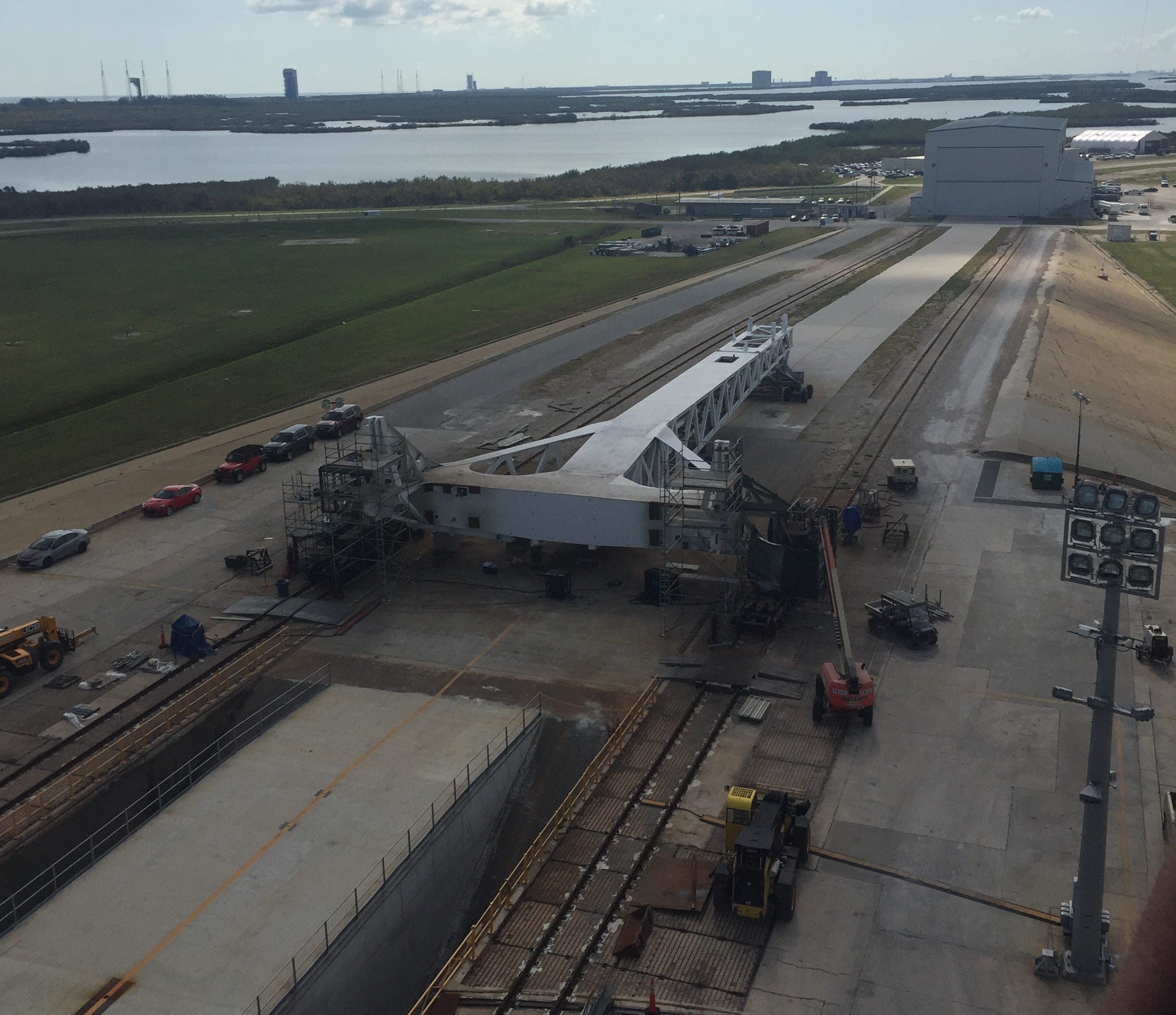
“I wanna build something big!”
I’ve heard this refrain a lot throughout my career. I heard it at the last company I built, I hear it from folks who want to join the new one, and I heard it at every space startup I worked, consulted, or advised at in-between.
But what does it mean?
Nothing.
Of course, that’s not to say that they aren’t trying to express something, it’s just that it’s a fuzzy sentiment not tethered to the reality of executing large missions. Generally, whenever I’ve probed, I’ve found that they don’t mean they want to assemble something that is literally large, they just want a perception of bigness in whatever they do. Put another way, they want to be a part of something grand. They don’t want to build something big, they want to feel big. This is a purely egoic urge and such sentiments of grandiosity, when pressed, scatter. They are nothing more than inchoate visions of future-focused external achievement and with it the illusion that there will be some glorious, final moment.
Unfortunately, there’s (at least) two issues with this. First, the arrival of a final moment means an end to life itself. It’s clear they’re not looking for that, but that’s the only way to inhabit an unchanging moment. Time is always flowing, and momentary glories are just that; they fade quickly. But that story is for another time. The second issue, the one I’m focused on here, is that there are no big things. Every thing is a small thing.
Look at the picture at the header of this post. That’s the “strong back” on LC-39A on Cape Canaveral about a decade ago. At a glance, it is a single large object, but in reality it’s thousands of small components working in concert. It was made bolt by bolt, weld by weld, vape hit by vape hit, cuss by cuss, one long sweating day in the sun after another. Behind each of those actions, a moment and a decision. Each of those, no matter how consequential it might have felt, was a single small action and each has massive importance.
This extends outward to the rest of the launch pad, too. One cannot set out with a grand vision to build something as complex as a launch pad and actually get very far. To make any real progress, we must break it down into smaller chunks that can actually be addressed. First we split the whole into a set of systems, then we divvy those into sub-systems, and then we define those using a common library of fluid process equipment (valves, regulators, pumps, and so forth). We arrange each of those components to achieve the desired outcome.
For the nerds and curious, note that the outcome is driven by requirements that, in a process system, boil down to two intrinsic variables of state. In that light, a launch pad is millions of dollars of equipment that ensures we have the right pressure and temperature at the ends of around three dozen pipes and hoses which feed into a rocket. Ditto, a nuclear power plant is all about managing pressure and temperature in the primary loop, and understanding steam tables in the secondary loop. These are the small things that we must manage and not lose sight of, it we want the large outcome of access to space or emission-free baseload power.1
Even when we manage those state variables properly on paper, the reality of managing them once they’re in the field is something else entirely. How many nights of sleep have I lost because of the failure of a small component? A 1,000 horsepower generator shut down at sea risking the mission because of a blocked fuel filter. A single broken spring in a valve actuator prevented the fuel bleed line from opening and almost scrubbing a launch. What good is the grand concept of a launch pad or landing barge if we can be stymied by unclean fuel lines no wider than my thumb, or broken springs that fit in the palm of my hand?2
The Trap of Grandiosity
When we fall into the trap of chasing “big” or “grand” things, we lose sight of the small, of what is real, what is present, and what is actually changeable. We find ourselves focused entirely on the ends and forgetting all about the means.3 When we search for a vague end like “working on something big,” with no real regard as to the means required to achieve it, we can end up a bit like a dog chasing cars in the middle of an interstate.
Somewhere in our mind is, perhaps, a voice saying we shouldn’t be doing this. But then we see huge semi-trucks of opportunity barreling down the road and we try desperately to latch on. I know well that it can be dispiriting to watch the world rush by and feel like we have nothing to grab, nothing that will take us at speed over the horizon. But God help us if we do latch on. Assuming we aren’t immediately turned into a roadkill appetizer (an amuse pooch?), we are overwhelmed by the speed, noise, and inertia of this thundering object.
But, to extend the metaphor, those trucks built momentum over time, through the concerted effort of thousands of tiny parts. And so, too, with us. There was likely a time in your life when learning to walk was your biggest aim. You probably don’t remember it, since you were likely very young, but if you have kids you know what it’s like to watch and cheer on those first proud steps. Now, however many years after that first moment, you probably don’t think about walking much at all. You might even shamble around with your phone in your hand, slumped shoulders, and craned tech neck, while your body performs a miracle that apparently requires over 200 muscles just to take a single step. But boy do we miss it if we ever lose it.
Grandiosity steals from us the ability to see things as they are — we always think we should have something bigger, something more. I had new engineers dissatisfied with their day to day work telling me that some day they’d leave Launch Co. and go do something real at SpaceX, somehow oblivious to the fact that SpaceX was our biggest customer and hired us to work alongside them.
Grandiosity also steals from us the ability to enjoy the present moment, to actually inhabit and live in it, rather than obsess over the future or the past, moments that may never, or at least no longer, exist. I fell into this trap when I sold Launch Co. in 2021. I remember the day the wire transfer came, it was momentous, everything I’d been waiting for. I was finally an exited entrepreneur and from now on everything would be great because I’d stepped through a magic gate … and also it was trash day and I forgot to put out the cans so I had to empty the overflowing cans and take them myself. Within three months, all the problems I thought would melt away had actually multiplied. I guess I focused so hard on the “massive win” as a single moment that I’d somehow forgot I’d have to keep living afterward.
But I learned, and am applying those lessons as we grow this new company. Most days, my job is simply to unblock the rest of the team. Some days that means fun things like hiring new team members, and others it means metabolizing bad news all day long. I don’t see myself at the top of the org, reigning as some kind of godhead from on-high. Instead, my role is to remove all the small blockers that and keep the team focused on what they’re best at.
So, I found it funny when we had someone complain that they felt their job was mostly “scut work,” humble details and unglamorous chores. Apparently they complained to both my co-founder and I, to which we both replied, “Yeah, it’s all scut work.” I guess they thought there was a secret room where leadership sat all day doing the grand things. Perhaps we’d make brave pronouncements, and bang our fists down to emphasize our brilliant points. Or we’d stand at the window, narrow our eyes at the rising sun, and try to glimpse the future.
But that isn’t how it works. I, too, do scut work, though I’d never heard it called that because it’s just work. I pay bills, meet investors, listen to the needs of customers, manage interpersonal issues, think of ways to serve the team. As I do each thing, I look for ways to implement automation so that I don’t have to think about them as much again, in the hope that we might go from walking to running.
In the two years of this new adventure, the job and what it needs from me have changed a lot as the company has sprinted through each phase. We’ve raised millions of dollars, grown to nearly 20 people, secured a half billion dollar IP deal, have three test stands in production, and are close to announcing our first commercial deployment. But as grand as I can make each of those sound, they’re nothing more than the amalgamated momentum built from focusing on the small; one single moment and human relationship at a time.
It’s also what makes big projects possible in stagnated industries — physics are physics, engineering is engineering, standards are standards, materials are materials, etc. We can adapt lessons from one sphere into another, as we did when we re-learned how to build launch pads, built landing sites for the first time. We are also taking this perspective into the new venture.
Our bodies work much the same way. Systems, organs, cells purposed to specific jobs, the parts of those cells, all the way down to molecules, elements, and atoms. Atoms breaking into subatomic particles, and perhaps all of it being defined by a single bit of information as part of the field. It sounds pedantic or theoretical until one of those tiny things goes wrong, until some atoms transform and some cells start to mutates, perhaps.